A Virtual Research Mentor — Not an Ordinary AI Tool
Vigyana supports researchers at every stage:
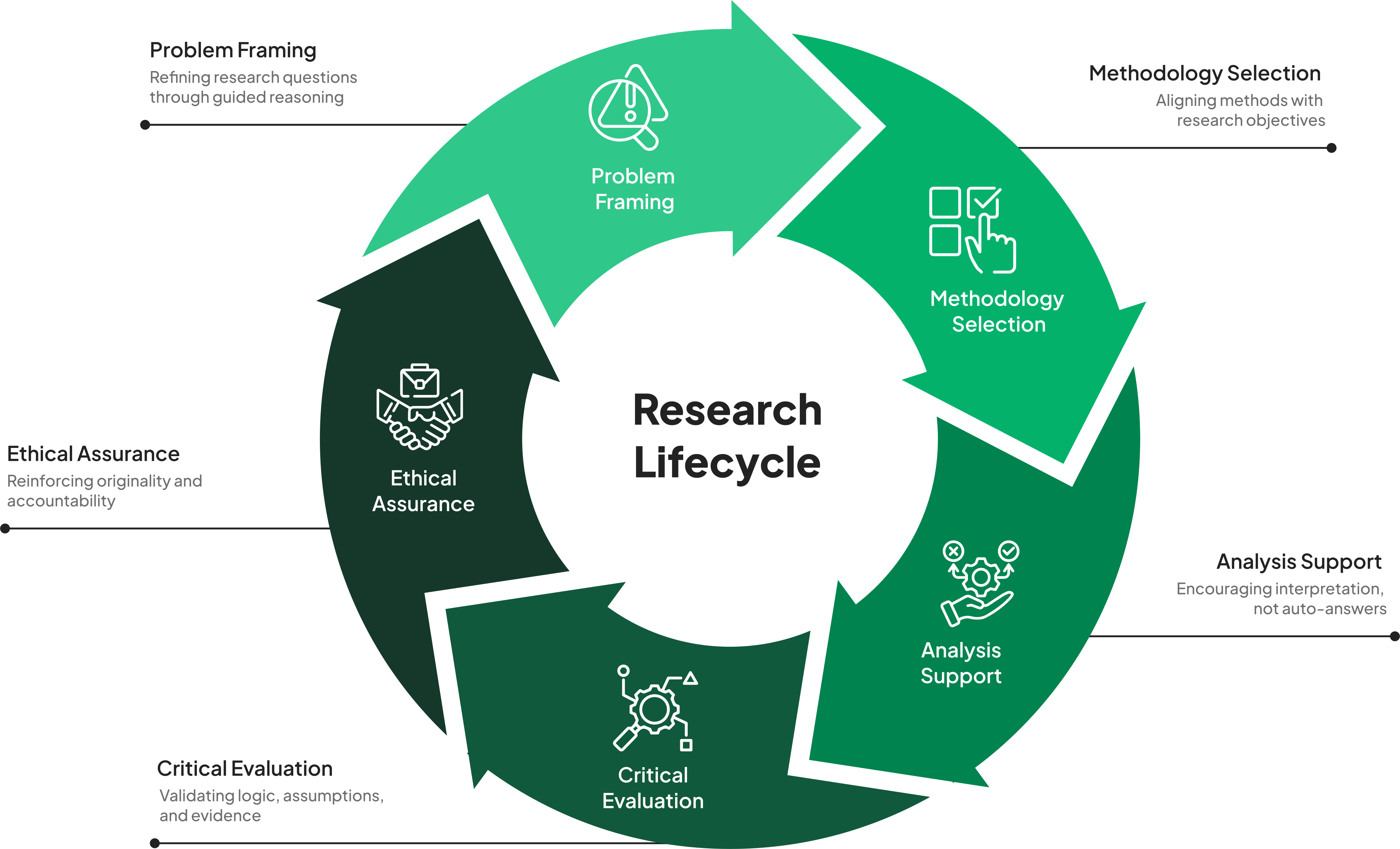
This ensures research outcomes are defensible, reproducible, and meaningful.
Vigyana is the only academic AI platform that integrates Artificial Intelligence, Research Methodology, and
Applied Critical Thinking into a single, guided research environment, enabling researchers to think clearly,
choose methods responsibly, and uphold academic integrity.
Vigyana functions as a virtual research mentor, purpose-built to support scholars with the cognitive depth,
ethical integrity, and methodological rigour expected of the world’s leading universities.
Despite increased investment and infrastructure, a large part of Indian research struggles with depth, originality, and continuity. The root cause lies in capability gaps that money alone cannot fix.
Breakthroughs fail without deep reasoning and conceptual clarity.
Over-reliance on familiar methods leads to stagnant research.
Findings remain descriptive, with limited interpretation.
Nearly 40% of Indian PhD scholars discontinue mid-journey, often due to lack of structured guidance.
Research rarely engages higher-order thinking—analysis, synthesis, creativity.
Limited originality results in low-impact, incremental research.
Eight Breakthrough Capabilities That Strengthen Research Thinking
Strengthens reasoning and conceptual evaluation.
Supports responsible method selection and application.
Encourages originality and meaningful questions.
Reduces roadblocks across the research lifecycle.
Enables integrated, analytical understanding.
Improves objectivity and interpretive rigour.
Supports complex and interdisciplinary research.
Promotes creative, cross-disciplinary insight.
Research is not content creation. It is a cognitive process involving question formulation,
methodological choice, analytical reasoning, and interpretation.
Every interaction in Vigyana is designed to strengthen thinking, not replace it.
Most AI tools for research prioritise speed. Vigyana prioritises substance.
Built by top research mentors for researchers, Vigyana empowers critical thinking, interdisciplinary exploration, and rigorous methodology, ensuring outputs reflect insight, not just intelligence.
This ensures research outcomes are defensible, reproducible, and meaningful.

This mentor-first design preserves academic integrity and intellectual ownership.
Vigyana is built on a Symbiotic Research Model, where AI partners with the researcher to
amplify intellect without creating dependency.
Core cognitive frameworks are informed by deep qualitative interviews with 19 senior researchers and validated
across a wider academic network of 90+ researchers.These insights shape Vigyana’s thinking pathways,
methodological guidance, and critical-reasoning models.
This is not automation of answers; it is augmentation of scholarly thinking.
Vigyana does not generate copy-paste content. Instead, it uses Socratic questioning, structured frameworks, and critical prompts to guide researchers in developing their own ideas, interpretations, and arguments. This approach reinforces intellectual ownership, original thinking, and ethical research practice, rather than shortcut-based content creation.
Vigyana supports research quality by strengthening research design, methodological alignment, critical reasoning, bias awareness, and interpretive clarity. Its guided approach encourages researchers to operate at higher cognitive levels, improving the defensibility, coherence, and scholarly depth of their work.
No. Vigyana is designed to complement, not replace, research supervisors and academic mentors. Human guidance, disciplinary expertise, and scholarly judgement remain central to research. Vigyana provides structured intellectual support that helps researchers think more clearly and engage more productively with their mentors.
Yes. Vigyana is discipline-agnostic. It supports research across sciences, engineering, social sciences, humanities, management, and interdisciplinary fields by strengthening thinking processes, methodological choices, and interpretation, regardless of subject domain.
Vigyana is designed for both individual researchers and institutional research environments. It can support personal research workflows as well as departmental or institutional initiatives focused on improving research quality, consistency, and ethical standards.
Vigyana aligns with academic ethics by promoting original thinking, transparent reasoning, methodological responsibility, and accountability. It discourages shortcut-based research practices and reinforces ethical use of AI as a thinking aid, consistent with institutional research integrity and quality assurance frameworks.